


3D network
Integrated architecture for governance, partnerships, and impact
Origin and Evolution
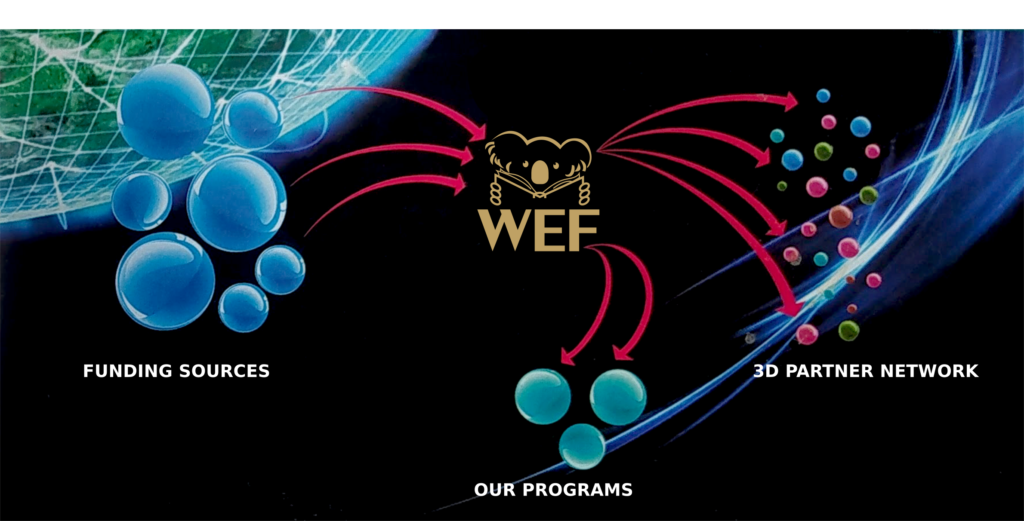
The 3D Project, now consolidated as the 3D Network, was conceived in 2011 as an institutional model designed to structure WEF’s activities through the articulation of funding, execution, and governance.
In its original conception, WEF positioned itself as a central hub, connected to funding partners, implementing organizations, and its own projects.
As of 2026, the model has been revisited and expanded to reflect the current stage of maturity of WEF Brazil and its integration into the Global Architecture. The 3D Network has evolved beyond a purely organizational concept and is now established as an integrated institutional infrastructure, capable of structuring networks, coordinating partnerships, and systematically expanding impact.
Structural Concept
The 3D Network is based on three complementary and interdependent dimensions:
Dimension 1 — Structured and Sustainable Funding
This dimension brings together private companies, public institutions, foundations, and individuals committed to responsible social investment.
It ensures:
- transparency in the origin of resources;
- legal and financial compliance;
- alignment with the institutional mission;
- medium- and long-term financial predictability.
Dimension 2 — Network of Partner Organizations
This dimension integrates third-sector organizations, educational institutions, foundations, cultural centers, and other entities with proven implementation capacity.
The objective is not to centralize or replace these organizations, but to:
- articulate competencies;
- share methodologies;
- leverage resources;
- organize coordinated network action;
- elevate governance standards.
WEF acts as an institutional curator and strategic coordinator, ensuring quality, alignment, and measurable impact.
Dimension 3 — In-House Projects and Structuring Programs
This dimension comprises initiatives developed directly by WEF, including:
- educational and vocational programs;
- science and research projects;
- environmental and social initiatives;
- institutional structures such as GEIF, WEF 100+, and WEF Idols.
These programs constitute the operational vectors that materialize the institutional mission.
Integration with IES
The International Education Society (IES) serves as the relational and digital arm of the 3D Network, connecting people, institutions, and knowledge within a structured environment.
IES is not an open network, but an institutional platform oriented toward qualified collaboration among:
- partner organizations;
- experts and educators;
- public sector leaders;
- social investors;
- private sector representatives.
Its functions include:
- strategic articulation among institutional actors;
- sharing of best practices;
- consolidation of methodologies and indicators;
- promotion of national and international dialogue;
- support for structured cooperation.
IES thus serves as the integrating element that connects the three dimensions of the 3D Network.mento integrador que conecta as três dimensões do Projeto 3D.
The Role of WEF Brazil
At the center of the 3D architecture, WEF Brazil performs essential functions:
- governance hub;
- institutional curation;
- strategic coordination;
- legal compliance assurance;
- organization of financial flows;
- definition of impact metrics.
WEF does not act as an isolated executor, but as an ecosystem orchestrator, ensuring coherence among resources, partners, and projects.
Strategic Objectives
The 3D Network is guided by clear objectives:
- to consolidate a solid foundation of governance and transparency;
- to structure a qualified network of partner organizations;
- to integrate local initiatives into WEF’s global architecture;
- to strengthen institutional credibility;
- to generate a measurable track record of impact;
- to establish a model that can be replicated across different countries.
Institutional Differentiation
The 3D Network stands out for:
- a planned, rather than improvised, structure;
- integration between governance and execution;
- rigorous partner selection criteria;
- focus on operational efficiency;
- use of clear performance metrics;
- alignment with international standards.
It is a model that combines institutional solidity with a contemporary vision of impact.
Scope and Expansion
The logic of the 3D Network is modular and scalable, enabling:
- progressive expansion of the partner network;
- structuring of regional hubs;
- integration with public policies;
- development of strategic partnerships;
- international replication within the Global Architecture.
Conclusion
The 3D Network consolidates an institutional vision developed over more than a decade, structuring the relationship between resources, partners, and projects in a coherent and systematic way.
More than an operational model, it represents a strategic framework for organizing social impact, in which governance, articulation, and execution converge toward a common objective: transforming educational investment into sustainable and measurable development.