

the IES
international education society
A global community for education, knowledge, and development

The International Education Society (IES) is the global community within the WEF ecosystem dedicated to connecting individuals, institutions, and ideas around a fundamental principle: education as a driver of economic and social development.
Conceived as an institutional platform for qualified engagement, IES brings together educators, experts, organizations, social investors, and leaders committed to transforming realities through knowledge.
More than a network, IES constitutes a structured society, guided by shared values, governance, and purpose.
Purpose
IES aims to build a global community capable of:
- connecting individuals and institutions with a genuine interest in education;
- promoting the exchange of knowledge and best practices;
- strengthening educational initiatives across diverse contexts;
- fostering international cooperation;
- contributing to sustainable development through human capital.
Institutional Nature
IES is neither an open social network nor an informal association.
It is a structured institutional platform, based on:
- curated membership;
- defined participation criteria;
- established governance;
- alignment with WEF’s core principles.
Its operation prioritizes quality of interaction, institutional consistency, and the relevance of its participants.
Participation Structure
IES organizes its members into different levels of participation, reflecting a diversity of profiles and forms of contribution:
- Individual Members: educators, researchers, and professionals;
- Institutional Members: schools, universities, organizations, and companies;
- Strategic Members: leaders, experts, and social investors.
This structure enables a plural, organized, and collaboration-oriented community.
Engagement and Interaction Dynamics
Participation within IES takes shape through:
- dialogue forums and institutional meetings;
- thematic groups and collaboration networks;
- national and international events;
- joint initiatives among members;
- exchange of experiences and methodologies.
Interactions occur in a structured manner, fostering relevant and productive connections.
Access to Knowledge and Best Practices
IES members benefit from a curated knowledge environment, including:
- studies and reports;
- educational methodologies;
- impact indicators;
- replicable experiences across different contexts.
This body of knowledge supports continuous development and contributes to raising standards of practice.ção.
Certification and Quality Seal
IES establishes mechanisms for institutional and professional recognition through:
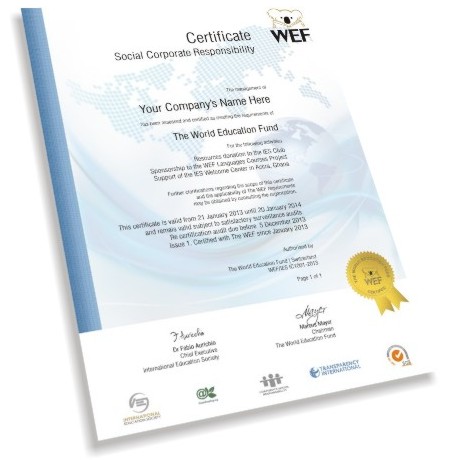
- IES Certification, awarded to individuals whose trajectory and work align with the principles of education as a driver of development;
- IES Seal, granted to institutions that demonstrate a consistent commitment to educational quality, social impact, and good governance practices.
These instruments reinforce credibility, recognition, and standards of excellence.
Integration with the WEF Ecosystem
IES plays a central role in articulating WEF initiatives:
- it connects with the 3D Network, acting as its relational dimension;
- it strengthens networks such as WEF Idols;
- it expands the institutional reach of WEF 100+;
- it contributes to the human and intellectual foundation that supports GEIF.
IES thus serves as a link between people, projects, and global strategies.s.
International Presence
IES follows WEF’s global structure, fostering connections across regions, with particular articulation among:
- São Paulo
- Geneva
- New York
- Nairobi
This presence promotes international exchange and supports the development of a truly global network.
A Community with Purpose
The International Education Society represents a new form of engagement around education — grounded in qualified collaboration, long-term vision, and commitment to real impact.
More than bringing people together, IES creates an environment where ideas evolve into initiatives, and initiatives into tangible results.
Conclusion
IES constitutes the human dimension of the WEF ecosystem, connecting talents, experiences, and institutions within a development-oriented community.
By integrating knowledge, relationships, and purpose, the society contributes to building lasting solutions capable of transforming education into prosperity.